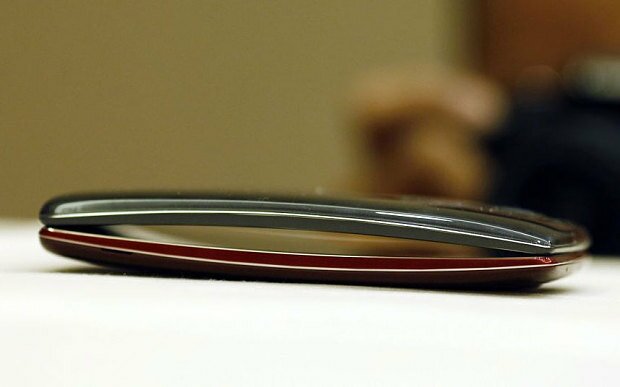
LG Display has announced plans to invest in a production line at the Gumi Plant in Gyeongbuk Province, Korea. Once fully ramped up, the plant’s monthly capacity will be double that of an existing production line for LG Display. The main advantage of a flexible OLED display is the screen’s bending feature that is achieved by the use of a plastic substrate instead of a glass substrate as in a conventional OLED display.
LG’s aggressive investment in flexible displays for mobile devices signals a potential broad shift in smartphone screen designs away from familiar rectangular flat screens.
“It is very likely that the first flexible iPhone may be introduced in 2018, as Apple’s top-tier display suppliers are working on it, ” claimed Korean media sources last month, and that might be one of the reasons behind LG’s near-$1 billion investment.
LG Display chief Han Sang-beom pledged earlier that the company will bolster the small and medium-sized OLED panels business as a future growth driver, in a bid to brace against a fall in demand for TV panels.
According to IHS DisplaySearch, a global market research firm, the flexible OLED market is expected to soar from 2015, with sales increasing from $3.5 billion in 2015 to $4.8 billion by 2021. The construction of the new facility, in the southern provincial city of Gumi, will be completed by the second quarter of 2017.
In a regulatory filing on Thursday, LG Display posted second-quarter earnings of 6.7 trillion won, up 12 percent from the same period previous year.
LG Display said the new facility should be able to produce flexible displays that are “foldable”, as well as displays that could be applied in automobiles.