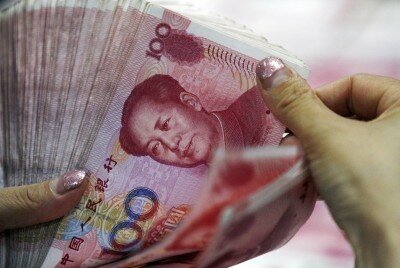
The central bank on Thursday set the yuan’s daily reference point just over 1 percent lower from the previous day, at about 6.40 per dollar.
On Thursday, the People’s Bank of China said it would not allow the yuan to plunge 10 percent as some fear it might.
Global stock markets were headed for a calm end to a volatile week, as a small rise in China’s currency soothed investors’ nerves following this week’s devaluation.
China’s decision to move from a pegged exchange mechanism to a managed-float system has partly been driven by the strengthening US dollar, the currency to which it has historically been pegged. The yuan’s weakness won’t fix that overnight. The euro was little changed at $1.1144, having gained 1.6 percent this week.
The People’s Bank of China (PBOC) said on Thursday that there are no grounds for persistent and substantial depreciation of the yuan in the long run while vowing to step in to prevent excessive swings.
Assistant governor Zhang Xiaohui said that, having in recent months been resisting downward market pressure on the currency, giving the market a greater say would inevitably mean allowing some depreciation, and that the 3% fall this week was necessary to diffuse downward pressure on the currency that had built up recently.
It also drew accusations from US politicians that Beijing was unfairly supporting its exporters. The Chinese move also drove investors to push back their expectations of when the U.S. Federal Reserve would raise interest rates, helping drive the dollar index to a one-month low of 95.926.
Zhang added that the value of the yuan has gradually returned to market levels, as the discrepancy between the central parity rate and the actual trading rate has been corrected, after declines in the past few days.
But ratings agency Moody’s said that the renminbi’s depreciation would “not have have material credit implications because it will not significantly bolster export growth“.
“Today’s fixing is in line with what they promised to do, which is to take account the previous day’s close”, said Dennis Tan, a currency strategist at Barclays Plc in Singapore.
China has painted the sudden devaluation as a move designed to give market forces more influence in setting the level of the yuan, increasing the likelihood that the worldwide Monetary Fund will include it in its basket of reserve currencies.
Analysts also rued a potential “currency war” if other economies seek to devalue currencies. The worry for that nation is that a weaker yuan will hit China’s imports, including products from Malaysia at a time when the nation is already facing lower commodity prices and the prospect of political instability.